
TECHNICAL PUBLICATION
Evaluation of High-Friction Surface Treatment Effectiveness Using Pre- and Post-Application Skid Tests
Martin Moreda, ACTAR 2562
Moreda Consulting, LLC
Peer reviewed and published in Momentum | 2026
Why This Research Matters
Roadway friction is a fundamental component of many accident reconstruction analyses. Friction values may affect calculations involving vehicle speed, braking distance, stopping distance and loss of control.
High-Friction Surface Treatment (HFST) is specifically designed to increase pavement friction at locations where additional tire-pavement interaction may improve roadway safety. When a collision occurs on an HFST-treated roadway, however, relying on generalized or assumed friction values may not accurately represent the friction actually available at the collision site.
This study evaluated the effectiveness of an HFST installation through controlled vehicle testing conducted before and after treatment, providing measured data concerning how the roadway’s available friction changed following installation.
Testing & Methodology
Controlled Pre- and Post-Application Testing
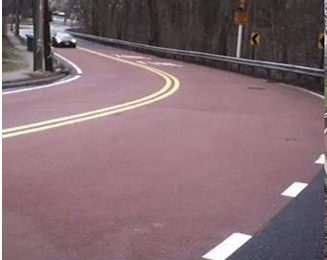
High Friction Road Surface Treatment
Testing was conducted at the same roadway location before and after installation of the high-friction surface treatment. The post-application testing was performed approximately nine months after installation, allowing the treatment to experience normal traffic and environmental exposure before evaluation.
Three passenger vehicles equipped with VC4000 accelerometers were used to conduct repeated braking tests under both dry and wet pavement conditions. Multiple test runs were performed with each vehicle to develop a representative range of measured friction values and permit comparison between the pre- and post-treatment roadway conditions.
Results
Measured Changes in Roadway Friction
Testing demonstrated increased available pavement friction following installation of the high-friction surface treatment. The most substantial and consistent improvement occurred under wet pavement conditions.
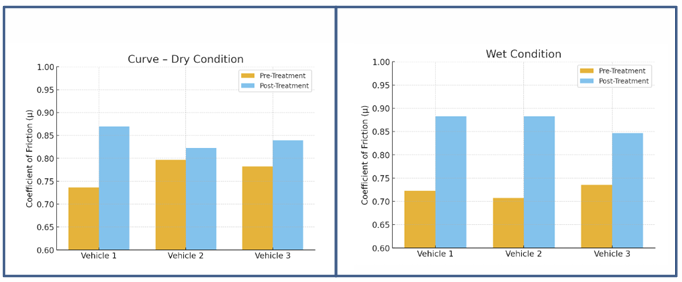
Comparison of measured pre- and post-treatment friction values under dry and wet pavement conditions.
Wet-condition friction increased approximately 15%–25% following HFST installation.
Under wet conditions, post-treatment friction values increased to approximately 0.85–0.88, compared with approximately 0.71–0.74 before treatment. The dry-condition results also showed increased friction, although the magnitude of improvement varied among the three test vehicles.
ACCIDENT RECONSTRUCTION IMPLICATIONS
Why Site-Specific Friction Matters
Friction values are frequently used in accident reconstruction analyses involving braking, stopping distance, vehicle speed and loss of control. The results of this study demonstrate that the available friction on an HFST-treated roadway may differ substantially from generalized or assumed roadway friction values.
When HFST is present at a collision location, the roadway surface should therefore be identified and considered as part of the reconstruction. Using a friction value that does not reasonably represent the treated surface may affect calculated braking distances, speed estimates and ultimately the interpretation of vehicle movement before a collision.
Site-specific testing, when appropriate and feasible, can provide measured friction data that more accurately represents the roadway conditions relevant to the analysis.
CONCLUSION
Measured Data Matters
The results of this study demonstrate that high-friction surface treatment can materially change the friction characteristics of a roadway, particularly under wet pavement conditions.
For accident reconstruction purposes, recognizing the presence of HFST is therefore important when evaluating the friction available to a vehicle before a collision. Where roadway friction is material to the analysis, measured site-specific data may provide a more technically supportable basis for reconstruction than generalized assumptions.
The study also illustrates the importance of documenting roadway surface conditions as part of the overall evidence evaluation. Changes to a roadway after a collision—including resurfacing or the application of high-friction treatment—may affect whether later testing accurately represents the conditions that existed at the time of the event.
Martin Moreda, ACTAR 2562
Moreda Consulting, LLC
Originally peer reviewed and published in Momentum, 2026.